
On January 16, China and Canada announced a Preliminary Joint Arrangement on Addressing Bilateral Economic and Trade Issues following Prime Minister Mark Carney’s visit to China. The agreement aims to “settle long-standing trade issues” and “establish a track for major new investments benefitting Canadian workers and businesses.” To date, both sides have made substantial progress on implementing the deal and there have been notable improvements in China-Canada trade relations. However, these developments have received relatively little media attention.
The agreement set forth a number of commitments from both sides on re-opening trade. Canada’s commitments include:
- Canada will lower its 100% tariff on Chinese electric vehicles (EVs) and provide an annual import quota of 49,000 EVs at the MFN tariff rate of 6.1%. Half of the quota will be reserved for EVs priced at $35,000 CAD or lower.
- Canada will extend previous remission measures for Chinese steel and aluminium products that are in short supply in Canada, and also expand remission coverage to 7 steel, 2 aluminium, and 4 steel derivative products by March 1, 2026.
- Canada will not impose tariffs on imports of certain solar products and semiconductors from China.
China’s commitments include:
- China will lower tariffs on Canadian canola seeds from 84% to 15% by March 1, 2026.
- China will remove anti-discrimination tariffs on Canadian canola meal, lobsters, peas and crabs by March 1, 2026.
- China will accelerate the resumption of imports of Canadian beef, pet food, animal genetics and other products.
In addition to trade, Canada also encouraged joint ventures with Chinese automakers in EV investments in Canada, with the goal to ultimately build out Canada’s EV supply chain and create new auto manufacturing jobs.
Canada’s progress on its commitments
- EV Imports
Canada implemented the EVs quota on March 1, 2026. On April 7, 2026, Canada also launched public consultations on its allocation and administration of the quota.
The quota is divided into two periods. The first period ran from March 1, 2026 to August 31, 2026, with a quota capped at 24,500 vehicles. The second period started on September 1, 2026 and is scheduled to run through February 28, 2027, with a quota of 24,500 vehicles plus any unused volumes from the first period.
According to the Canadian government’s utilization data dashboard, in the first period of the quota, a total of 15,603 Chinese EVs were imported. Most of the imported vehicles were electric passenger vehicles. Despite the quota being implemented in March, imports under the quota did not begin until May.
The first period quota allocation for EVs was 8,897 units short of the allowed amount, so the second period's total available quota increased to 33,397 vehicles. In September, 603 vehicles were imported.
- Remission on steel and aluminum imports
On January 30, 2026, Canada registered an amendment to the China Surtax Remission Order, expanding the list of Chinese steel and aluminum products eligible for remission from the 25% surtax introduced back in October 2024. The amendment extends remission eligibility through December 31, 2026.
Specifically, the amendment adds nine new product entries to Schedule 1, covering specialized steel products such as zinc-coated steel, stainless steel wire, tool steel bars and seamless steel tubes, as well as two categories of aluminum sheets.
China’s progress on its commitments
- China’s commitment to lower tariffs on Canadian canola seeds
China initiated an antidumping investigation on imports of canola seeds from Canada on September 9, 2024 and imposed an antidumping duty of 5.9% following its final determination on August 12, 2025. On February 28, 2026, however, MOFCOM removed antidumping duties on Canadian canola seeds.
In 2024, China imported $3.2 billion (USD) worth of canola seeds from Canada. Canola seeds were China's third-largest import from Canada by value, behind petroleum and gold.
After the imposition of antidumping duties, canola seeds shrank by nearly three times by value, to just $1.3 billion in 2025.
In 2026, canola seeds imports started to recover after the removal of antidumping tariffs. By October, cumulative imports had already surpassed total imports in 2025 and reached $1.6 billion. Looking at year-over-year data, imports started to grow starting from May. For example, May 2026 imports increased by 91% from $156 million in May 2025 to $300 million, June 2026 imports increased by 236% from $95 million in May 2025 to $318 million, and July 2026 imports increased by 178% from $102 million in May 2025 to $283 million.
In some months, imports also exceeded their corresponding 2024 levels. Imports in May, June and July this year increased from their 2024 levels by 32%, 5%, and 41%, respectively. However, imports in August and September remained lower than their 2024 levels.
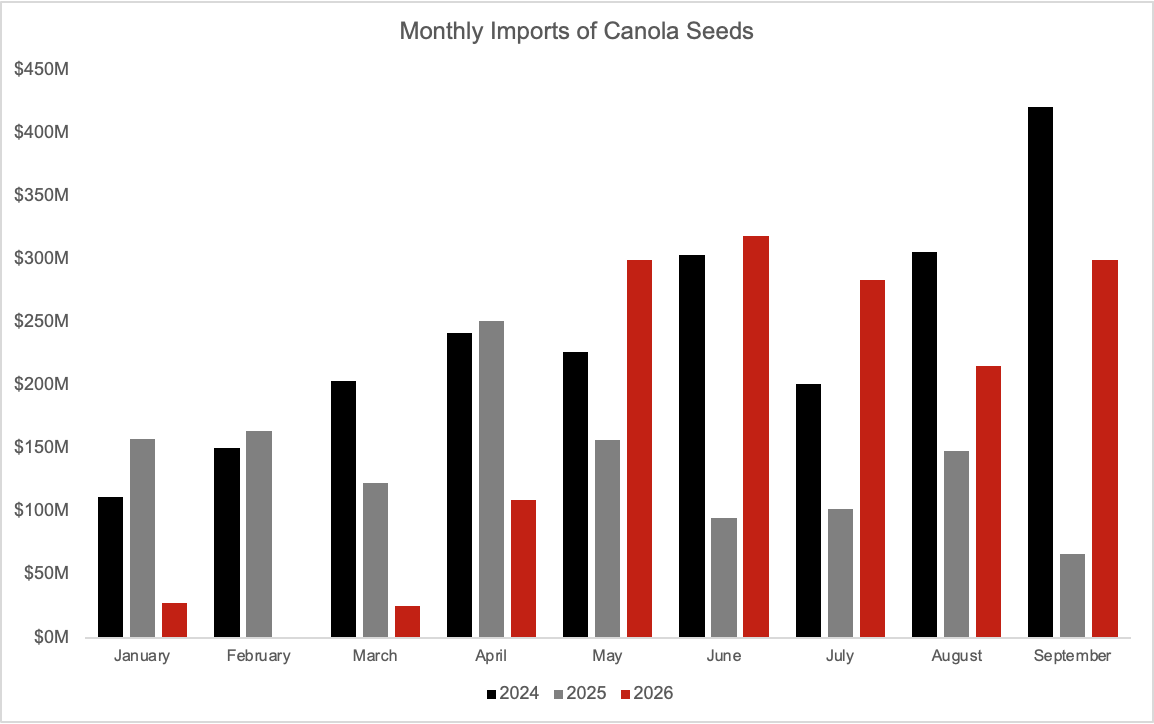
*Import data for HTS code 12051090 (Other low erucic acid rape or colza seeds); Source: Customs Statistics, General Administration of Customs of China.
- China’s commitment to lower tariffs on other agricultural and seafood products
Following Canada’s decision to impose a 25% tariff on steel and aluminum imports from China in October 2024, China imposed retaliatory tariffs of 100% on imports of canola meal, peas, and 25% on pork and seafood imports (lobsters and crabs) in March 2025. The Customs Tariff Commission of the State Council announced the removal of tariffs on canola meal, peas, and lobsters and crabs, effective from March 1, 2026 through December 31, 2026.
While these products only make up less than 5% of China’s total imports from Canada, their import values declined significantly in 2025 following the imposition of tariffs. Annual import data shows that canola meal imports experienced the largest decline, falling by 62% compared to 2024, followed by lobsters (44%), crabs (33%), and peas (20%). After the removal of the tariffs, canola meal and peas imports have started to recover, while crabs and lobsters imports still remain low.
Imports of canola meal
China’s annual imports of canola meal from Canada declined by 62% from $783 million in 2024 to $294 million in 2025. Imports of canola meal started to grow from June this year, increasing by 39% year-over-year from $34 million to $48 million, although they remained below the $72 million recorded in June 2024. However, starting from July, monthly imports of canola meal have surpassed 2024 levels, reaching $83 million, $65 million and $114 million in July, August and September, respectively.
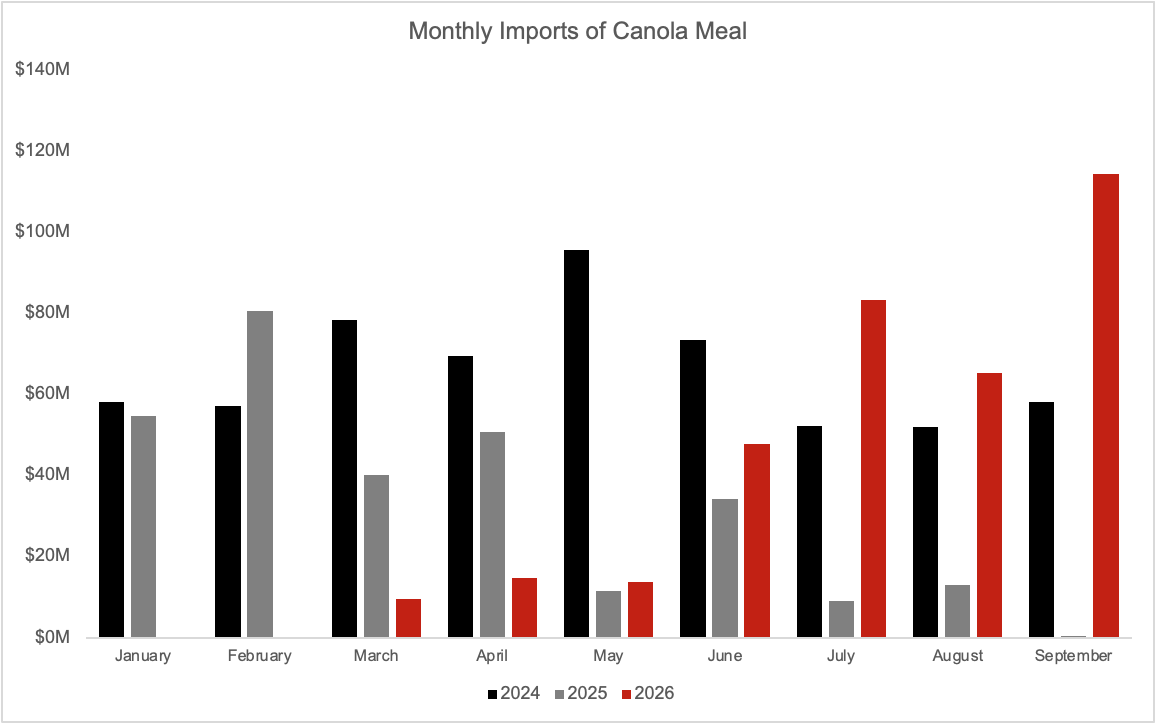
*Import data of HTS code 23064100 (Oil-cake & other solid residues of low erucic acid rape or colza seeds); Source: Customs Statistics, General Administration of Customs of China
Imports of peas
China’s annual imports of peas from Canada declined by 20% from $264 million in 2024 to $212 million in 2025. Imports rebounded sharply in April following the removal of tariffs, with monthly import values consistently exceeding their corresponding levels in both 2024 and 2025. By September 2026, cumulative imports had reached $298 million, already exceeding the full-year totals for both 2024 and 2025.
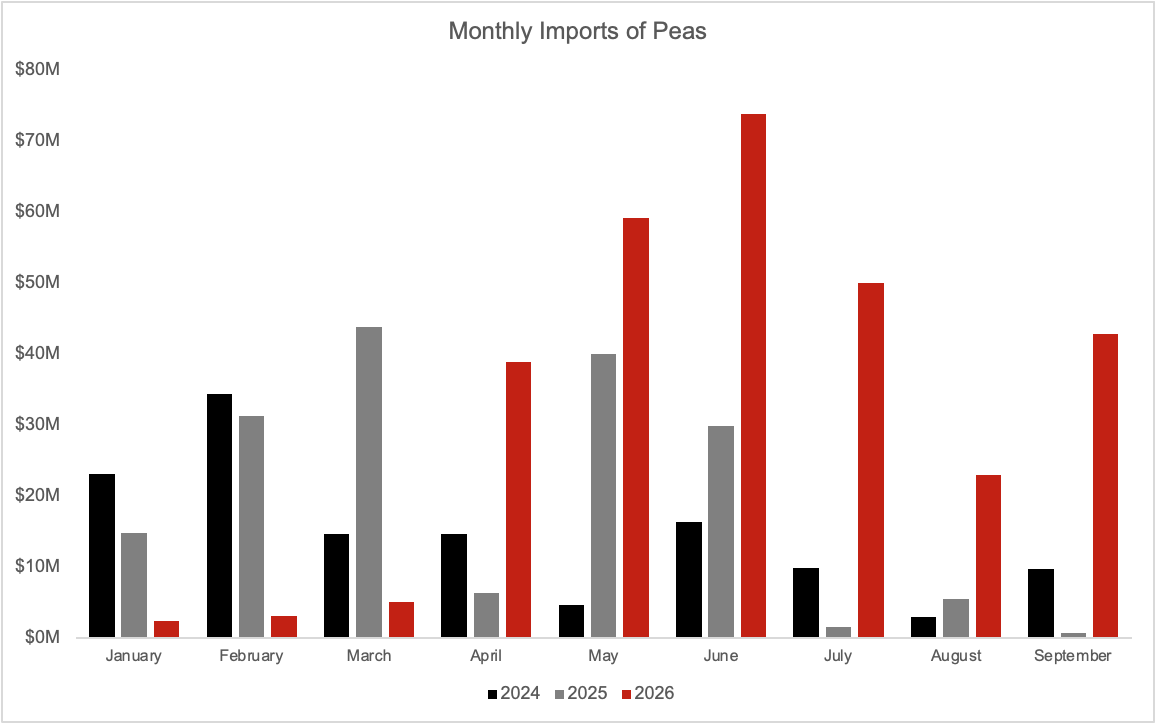
*Aggregate data of HTS code 7102100 (frozen peas) and 7131090 (dried peas); Source: Customs Statistics, General Administration of Customs of China
Imports of lobsters
China’s annual imports of lobsters from Canada almost halved from $691 million in 2024 to $385 million in 2025. Although lobsters experienced year-over-year increases every month beginning from April this year, import levels still remained below 2024 levels. September imports showed some signs of recovery: lobster imports reached $77 million - the highest monthly import value since January 2025, overtaking September 2024 imports by $5.4 million.
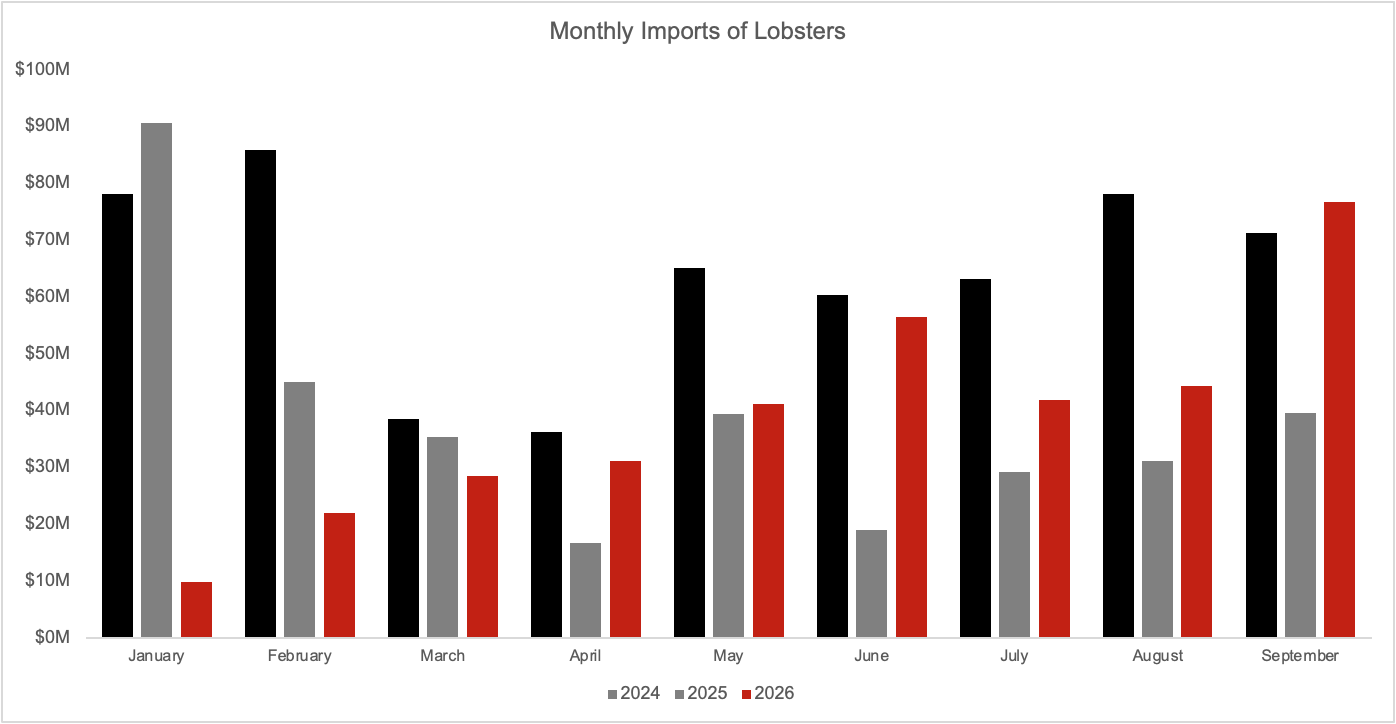
*Aggregate data of HTS code 3061200 (frozen lobsters), 3063290 (fresh lobsters), 16053000 (preserved lobsters); Source: Customs Statistics, General Administration of Customs of China
Imports of crabs
China’s annual imports of crabs from Canada declined by 40% from $188 million in 2024 to $112 million in 2025. Unlike other products that received tariff relief, crab import levels have not recovered in 2026. With the exception of September, imports trailed behind 2025 levels and 2024 levels in every month. September imports reached $15 million, marking a year-over-year increase of 32%, but still fall behind the $16 million of imports in 2024.
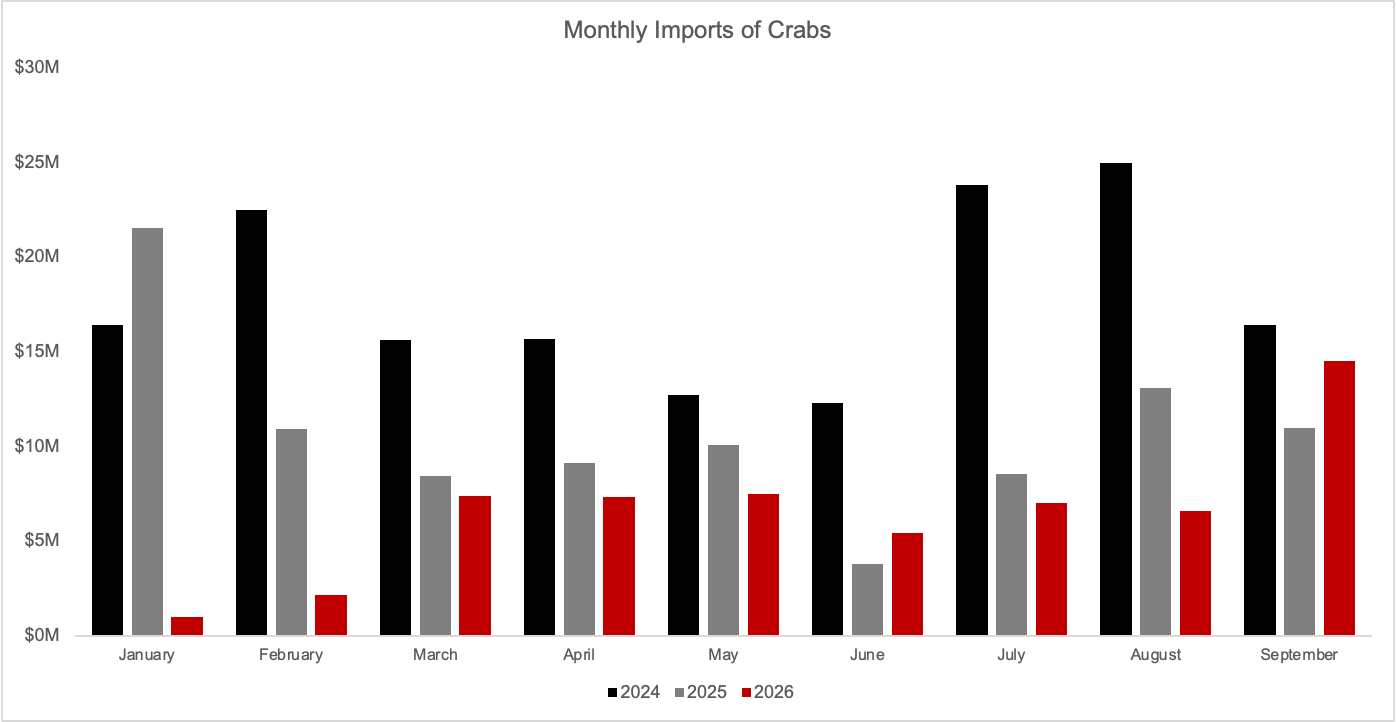
*Aggregate data of HTS code 3061490 (frozen crabs) and 3063399 (fresh crabs); Source: Customs Statistics, General Administration of Customs of China
Market access for other agricultural products
In addition to lowering tariffs, China has also taken steps to fulfill its commitments to restore market access for certain agricultural products.
Since January, the General Administration of Customs of China (GACC) has resumed export licenses for 20 beef exporters in Canada, following the suspension of beef imports from Canada in 2022 after Alberta reported a case of bovine spongiform encephalopathy (BSE, or ‘mad cow disease’). Companies that had export licenses reinstated include major meat suppliers like Cargill, JBS Food, Montpak, as well as cold chain providers like VersaCold and Congebec. With no explanation provided, GACC suspended JBS Food’s license on September 10. So far, beef imports have reached $242 million, with frozen boneless beef making up the most of the imports. (Aggregate data of HTS code 02012000, 02013000, 02022000, 02023000 from Customs Statistics.)
GACC published a notice on February 2 outlining inspection and sanitation regulations for pet food imports from Canada, permitting pet food imports that meet the specified criteria to enter China. Pet food imports remain low nonetheless, totalling just $4.4 million so far this year (data of HTS code 23091090 from Customs Statistics).
Although GACC has not published any official notices, Reuters reported that China has resumed importing animal genetics from Australia and Canada. According to China’s Customs Statistics, China has imported $1.5 million worth of bovine semen and $13,900 worth of other animal semen so far this year (aggregate data of HTS code 05111000 and 05119910 from Customs Statistics) .
- China’s EV investments in Canada
Chinese automakers have also made progress in expanding their commercial presence to Canada. Major automakers have begun to set up retail and service networks in Canada. For example, Chery has posted hiring announcements for engineering, intelligent technology, and compliance positions in Canada, BYD has hired an auto retail consultant for scoping locations for retail stores, and Geely has confirmed it is actively preparing for a commercial launch in Canada.
Beyond establishing retail and service networks, some companies have reportedly expressed interests in building or acquiring factories to set up manufacturing in Canada - though no company has announced official plans to start manufacturing there yet. Chery’s Executive Vice President, Guibing Zhang, has said that some of the options considered for expanding into the Canadian market include taking over idle capacity at existing plants and working with partners, claiming that “Canada is a market that is worthy of having a factory for manufacturing”.
BYD’s Executive President Stella Li revealed that BYD is also studying the Canadian market for a potential manufacturing plant, though she has added that BYD would want to own and operate such a factory, rather than working through a joint venture. Patrick Brown, the mayor of Brampton, Ontario, has said that BYD approached him earlier this year about manufacturing buses at an idled plant.
Apart from full vehicles, auto part manufacturers have also expressed interest in expanding investment in Canada. Canadian OEM Stellantis has discussed options with its Chinese partner, Leapmotor Technology, for turning the idled factory in Brampton that BYD has inquired about into a factory dedicated for building EVs.
UPDATE
On November 4, China and Canada agreed to a two-year extension until the end of 2028 of the favorable market access for Canadian canola meal, peas, lobsters and crab, following the Joint Economic and Trade Commission meeting in Beijing. Additionally, Canada also agreed to extend remission measures for certain Chinese steel and aluminum products to the end of 2028. According to MOFCOM’s press release (link in Chinese), Canadian Minister of Trade Maninder Sidhu also encouraged Chinese companies to expand investments in agriculture, manufacturing, financial services and energy in Canada.